Tuesday, March 20, 2012

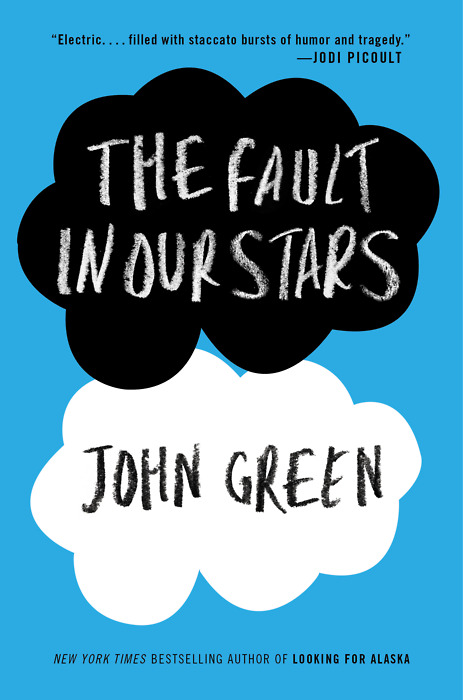
The Fault in Our Stars

Author: John Green

I read a book about dying from cancer. I laughed all the way through. I then pondered long and hard as to where I would review this. 350Wordsorless is for books actually inthe Odell Learning Resources Centre library. As you can tell, I’m going to get this book but may display it in my office while I’m thinking through the harder questions. 

I simply wouldn’t bother scratching my head over a poorly written or insignificant book… but this is neither. The story is told by Hazel, a seventeen year old who does not go to college much, and has become fixated on a particular book (an invention of the author) called An Imperial Affliction. Hazel’s life has been somewhat constrained by having serious cancer, so serious that she is permanently on oxygen and, as far as she knows at the start of the book, facing only a limited time left on earth. 

Almost everything that follows is the opposite to the reader’s expectation. Hazel fits no simple stereotypical cancer victim persona. She is feisty, but refuses to be “brave”. Her parents are admirable and understanding, and while she finds them irritating at times she does not hate them. While many of the people you meet in the book also have cancer of various sorts, some very significant people in her life do not. Hazel is not exactly an ordinary teen, despite her “teenspeak” language, and shows a distinctly philosophical bent (in part influenced by the book she can’t stop reading and thinking about). 

Hazel questions much of the conventional “dance” of the cancer patient… doctor’s attitudes, support group platitudes, even her parents insistence that she “gets out more and makes friends”. She does, with unexpected consequences. 

This is not a self help book about coping with cancer. It is a book about friendship, romance and serious relationships, philosophy, death, grief, family and afterlife. While most of it is reasonably realistic, Hazel does encounter at least one larger than life character, but even he is essentially made up of super failings rather than super powers. 

I enjoyed this from cover to cover… so if you are reading this as a parent you will be wondering what could possibly cause me any concern (spoilers follow). Writing: very nicely done, swinging from “teen speak” to philosophy and back. Language: not too bad, mostly restrained. Violence: emotionally tough in parts but no physical violence. Sex: Hazel does go to bed with her boyfriend. It is handled discreetly but there is absolutely no doubt what does happen. Morality and overall hopefulness: this is a book that investigates death from cancer from the eyes of a teenager, and is consequently potentially harrowing for some. It does it (I believe) very well. Family allegiance is celebrated, as is faithfulness to friends and to those you are romantically involve with. Generosity, honesty and a kind of gritty positivity is pushed to the forward. Christianity: some of the Christians in the story are not shown as being especially helpful or responsive to Hazel’s real needs or ideas, on the other hand both sets of parents in the book seem to be church goers and this is not handled negatively. One of the characters believes in life after death (though not necessarily in a straightforward Christian context), another does not. 

So now you know… or at least enough to say “that’s the book for me” or “nah… not so much”. I hope adults do read this book… and I think it will have some positive things to say to teenagers who venture into its pages. Remember how I started? It’s a book about dying from cancer, and I laughed all the way through. 

Andrew Lack
Head of the Odell Learning Resources Centre

Wednesday, March 14, 2012

The Dragon’s Tooth

 Author: N.D. Wilson

A boy throws two old tires into an empty swimming pool, picks up a ringing phone in a dilapidated motel, and hears the voice of someone demanding to stay that night in Room 111. Cyrus (the boy) is furious when his older brother allows the stranger to stay in the room, as in fact it is his own bedroom, however by the morning, everything has changed. A night of fire, murder and strange events means you have entered an N. D. Wilson story. 

The author’s first series, 100 Cupboards, was an engaging American Fantasy series, and this book is the start of a new series. There are some things in common, but for those already missing the unionised fairies and hand carved wooden typewriter of the first books, I have to point out this book has a very different premise. In both cases the introductory book is especially attractive because it sets up a number of mysteries. In both cases the focus is not on an individual hero but on a family with a secret history… but not a family with innate or mysterious powers. 

Despite the title, the book is not about a world of high fantasy (dragons, elves and spells). Instead it proposes an ancient secret society whose purpose is to incarcerate forces of evil that seek to ravage the world. Their tools include guns, genetically enhanced dragon flies and planes as well as some more mysterious objects such as the dragon’s tooth fragment of the title. The book has at least has a very clear distinction between good and evil, with a particularly nasty master villain who dabbles in genetic modification of those he captures. I’m interested that in an end note the author talks about trying out sections of the book as bedtime stories for his own young children, as there is a quite strong violence and some very nasty characters. 

Some of the mechanisms are familiar from other stories, but both in his first series and in this book Wilson shows many distinctively original touches and ideas. I also enjoy reading his books as an adult, as he is quite capable of using beautifully crafted images and language. If I have a criticism apart from the violence it would be that some of the physical adventures and trials of Cyrus and his sister Antigone are rather over the top, however it does seem ironical to be talking about “realism” when in the throes of a fantasy story. 

So, the start of another series by an interesting writer with a good pedigree: some magic and horror elements and relatively strong violence, clear distinction between good and evil, and writing that is at times quite literary. 

Andrew Lack
Head of the Odell Learning Resources Centre

Tuesday, March 6, 2012

The Lake of Dreams

Author: Kim Edwards


This is rich fare but tasty. We start in Japan (that had me in from page one) as we meet the narrator Lucy Jarrett. She is living there with her partner Yoshi. Gradually themes emerge from her narrative about the details of the day (peppered with earthquake shocks). It becomes clear we are going to be looking at the idea of family relationships, the role of the near and far past in impacting the present, ideas about domesticity and independence, food, fine art and beauty. The book seems initially to be a fairly light read, but partly due to a small font and partly due to the gorgeous descriptive passages it took me longer than expected. 

Lucy journeys back to her home town (by the Lake of Dreams). Nothing is as she remembers it: her mother is falling in love with someone she has met, her uncle seems bent on purchasing pristine lake frontage and commercially developing it, and a former boyfriend is now a much talked about glass blower in the “crafts” section of the town. We walk with Lucy through small events, interactions and discoveries, and gradually the pace and intensity picks up. She becomes intrigued by evidence she discovers of an unknown relative two generations prior, and this becomes the focus of one of the larger story arcs. 

The book is well crafted, with a pacing that ebbs and flows, but I was interested till the conclusion. There are moments of high drama with particular revelations, but it is less about the surprises than gradual uncovering of dimensions in her own past that end up feeding significantly into her present dilemmas. The process of story telling is therefore more like polishing an old vase until you can start to see your own reflection. 

It is unlikely to attract younger teens given the lyrical passages, multi-layered narrative and rich use of interlinked motifs: recommended for older teens and adults. There is certainly reference to adult themes and interactions but little to be uncomfortable about.

Andrew Lack
Head of the Odell Learning Resources Centre

Wednesday, February 29, 2012

Mummy laid an egg!

Author: Babette Cole

Children are naturally curious. One question that they really puzzle over is “Where do babies come from?”. Parents need all the help they can get to tell the biological truth in a fun way.

Babette Cole puts a hilarious twist on one of the most difficult yet important discussions necessary in their development. In the book the Mum explains “Girls – sugar and spice and all things nice”. Dad says “Boys, slugs and snails and puppy dogs’ tails”. Suggestions from the adults include “squidge them out of tubes of baby paste”, “make them out of ginger bread”, “grow them from seeds in the green house” and other whimsical nonsense.

The children in the story decide to illustrate with childish drawings the whole baby making process, so that their parents will no longer be as deluded as their silly answers imply.

Some parents may find the sketches unsuitable for young children. You can check it out on YouTube – or borrow it from the Odell Learning Resources Centre. This is a fresh and delightful way to convey some helpful detail about bodies and babies.

Gayle Davidson
Odell Learning Resources Centre

Tuesday, February 21, 2012

The Chemistry of Tears

Author: Peter Carey


I’m a little cautious opening a Peter Carey book. Like many people I found Oscar and Lucinda a rather difficult book to read, with such tortured characters and dense writing. The Chemistry of Tears is a more accessible read (I’m pleased to report) though about another tortured soul. 

The narrator, Catherine, works in a British Museum as a clock and clockwork specialist. The story opens with her arrival at work only to discover that her workmate and secret lover of thirteen years has died suddenly of a heart attack. She is utterly devastated, trapped by the knowledge that she cannot share her grief with anyone. 

It turns out that someone does know… her boss, Eric Croft. With somewhat mysterious motivations, he arranges for her to take on thee extraordinary task of assembling an old automaton (shades of Hugo Cabret). In her grief-stricken altered state, she steals the voluminous notebooks found in the packing box, and we start to read the bizarre story behind the automaton interspersed with Catherine’s increasingly complex reactions to her bereavement, its consequences, and the very strange assistant who Croft provides. 

Not everyone enjoys the “two stories in one” structure, and I admit I hurried through some of the notebook narrative, but only because I was keen to find out more about Catherine. Some of her world and past is revealed, but this perhaps is a book more about grief, anxiety and obsession than about the narrative of a character’s whole life. The dramatic arc that is certainly there in both tales is more of growing complexity and mystery rather than of dramatic action. 

This will suit a reader prepared to deal with complex ideas and strange characters, but if that is not a barrier, then this is certainly worth a read. I note for parents that there is some explicit drug use and sexual references. Recommended for young adults and up, though due to the layers of complexity it is no casual light read. 

Andrew Lack
Head of the Odell Learning Resources Centre

Wednesday, February 15, 2012

The Coming of the Whirlpool

Author: Andrew McGahan


Dow Amber is the son of timber getter. When he is of age he follows his father and the men of the village up to the plateau to fell trees. While there his heart is stolen... not by a girl, but by an unexpected glimpse of the wild, surging ocean at the base of a headland. His safe world is unmade, and his fate is now to walk in strange and difficult paths. 

Andrew McGahan is an Australian author with several adult novels to his credit, including the Miles Franklin winner The White Earth. This book is the start of a fantasy series aimed at teens. When I say fantasy, I need to clarify that there are no elves, dragons or magic rings in this book, and no magic or monsters (though he may have some in store for later books). It is however set in a world that is almost but not quite Earth... a world with a much reduced level of technology.

In that world the Ship Kings have come to dominate and rule over other island people, and Dow’s fascination with the sea is going to bring him into rapid conflict with these inflexible rulers who allow no one else to even sail out at sea.

The writing is for the most part confident and effective. The various characters are interesting, the situations mostly believable, and there is a sense of several sub plots emerging. The language is more formal than I may have expected, but this is McGahan’s ploy to create a distinct “story telling” tone. It is clear from the cover (Ship Kings Book 1) that this is going to be a series, but he completes the story for this book in satisfactory way. My only real reservation is that in the most dramatic adventure or action section (the actual whirlpool of the title) I think both the physical phenomenon and the human action are a bit over the top. Still, he warns at the start that this is a different world with different rules. 

I will be interested to see how the story continues. It is a bold move to write a book that is in so many ways a fantasy adventure, yet to avoid the supernatural, fantasy world creatures and magic. There are likely to be larger forces at work, but so far they are described as fate, blood inheritance and a curse... and these are ideas expressed by characters, not directly by the author.
A good read for Year Five and above, and an interesting opening salvo from a good Australian author.

Andrew Lack
Head of the Odell Learning Resources Centre

Sunday, February 5, 2012

The Blood Red Road

Author: Moira Young


I finished this book a little confused. Is it a western transported into a dystopian future? Is it Sci Fi but without the aliens and gadgets? Is it a love story? Of course breaking genre boundaries is no crime, indeed can win you the Pulitzer Prize (A Visit from the Goon Squad). The problem here is whether the final result works. The folk who awarded this the 2011 Costa Book Award liked it… I was less certain. 

In a bleak future (presumably America) technology has been reduced to medieval level. Evidence of “The Wreckers” (presumably modern Americans) is everywhere, but mostly as scrap. A small family ekes out an existence beside a drying lake. The older children, Lugh and Sada, are twins. On one disastrous day Lugh is kidnapped and Sada vows to rescue him from the riders who have claimed him for a mysterious purpose. Though she is only eighteen her fighting ability and determination will lead her on many strange adventures as part of this mission.

To make life even more difficult she is also responsible for a younger sister, who she cannot love as she blames her for their mother’s death. She also meets Jack along the way, and Jack she finds fascinating and dangerous in equal proportion. 

The story is told in the first person from Sada’s perspective, and she is given a sort of “western” American dialect. Strangely (for a world so far in the future) there are very few new words, simply contractions like “gonna”, “fer”, “outta” and “git”. It is quite easy to read but I feel the author missed on an opportunity to have a more creative look at our ever mutable language. The stuff in the book could easily come from any western novel. 

The book is not really “Sci Fi” in most senses. There is no new technology, no aliens, just a bleak reduction of the future into the past. I personally also found it rather odd in the way it flicks between the love story between Sada and Jack, and the often quite intense action and violence of the rest of the book. Many of the ideas reminded me of other novels: it is not wrong to borrow, but I expect a blend of new and generic at least. The wise crow? Try The Hobbit. The older sister sacrificing herself for the younger? Hunger Games. The cage fighting in Hopetown? Mad Max Beyond Thunderdome. Even the land yacht is not so far away from Mortal Engines. A population enslaved by drugs? A Scanner Darkly.

I read to the end, but I’m not convinced I’d read another volume (as the series seems destined to continue). Can one come up with truly new ideas in fantasy or “future” novels in an American setting? Certainly! Orson Scott Card does an amazing job in the Alvin the Maker series, and more recently N D Wilson created a fascinating American fantasy with The 100 Cupboards series. I suppose The Blood Red Road comes closest to something like Tomorrow When the War Began. While Hunger Games is possibly more horrifying in the pitting of innocent against innocent, it also has to my way of thinking a much stronger moral centre. 

Suitable for teens and up, with a note that there is a range of intense and fairly graphical scenes of fighting and its consequences. 

Andrew Lack
Head of the Odell Learning Resources Centre